
Northern Cyprus eSIM: Connecting From Kyrenia to Famagusta
Discover Northern Cyprus eSIM guides, network operators, installation steps, and connectivity tips for your trip.
In this article
Northern Cyprus has a way of surprising people who arrive expecting a smaller, quieter version of the island's southern side and instead find Venetian fortresses, Ottoman mosques, Crusader castles perched on mountain ridges, and beaches that still feel genuinely uncrowded even in peak season. It's a destination that rewards curiosity, and getting online the moment you land at Ercan Airport makes that curiosity easier to act on, whether you're mapping a coastal drive toward Kyrenia or trying to figure out which gate leads into Famagusta's old walled city.
This guide walks through how Northern Cyprus eSIMs work, which local networks perform best, what data plans typically include, how to get everything set up on your phone, and a solid tour through the region's most rewarding places to visit.
Why an eSIM Makes Sense for Northern Cyprus
An eSIM is a chip built directly into your phone that gets activated remotely through a QR code scan, replacing the physical card and the whole process of finding a shop, showing identification, and waiting for someone to register your line manually. For Northern Cyprus, this convenience lands well because the region operates its own telecom infrastructure separate from the island's southern side, meaning a SIM purchased in one part of Cyprus generally won't work seamlessly across the administrative line, and travelers often end up needing separate connectivity depending on where their itinerary takes them.
Landing already connected means you can pull up directions to your hotel in Kyrenia, message ahead to confirm a dinner reservation overlooking the harbor, or simply check opening hours for a castle before driving thirty minutes up a mountain road to reach it. Installing your eSIM before departure, using your home WiFi rather than fumbling through settings at an unfamiliar airport, turns arrival into something calm rather than chaotic.
Most smartphones from around 2018 onward support eSIM technology, covering the bulk of recent iPhone and Android models. A handful of devices sold in specific regional markets ship without eSIM enabled, so checking your exact model ahead of time saves any last-minute scrambling.
Northern Cyprus's Mobile Network Landscape
Two main operators serve Northern Cyprus: Turkcell and Vodafone, both running localized networks specific to the region rather than simply extending coverage from mainland Turkey or elsewhere. Turkcell generally holds strong coverage across the major towns and connecting highways, including the coastal route linking Kyrenia, Nicosia, and Famagusta. Vodafone performs competitively in the same areas and has built out solid infrastructure across the more developed tourist zones along the north coast.
Coverage across Northern Cyprus tends to stay dependable given the region's relatively compact size and well-connected road network. Even areas that feel remote, like the Karpaz Peninsula stretching out toward the island's northeastern tip, maintain workable signal along the main coastal road, with slightly thinner coverage once you venture onto smaller dirt tracks leading toward the peninsula's quieter beaches.
An eSIM provider offering access to either network, rather than locking travelers into just one, gives phones the flexibility to grab whichever signal performs best in a given spot, which matters more once your route starts weaving through mountain passes or coastal back roads.
Kyrenia: A Harbor Worth Building a Trip Around
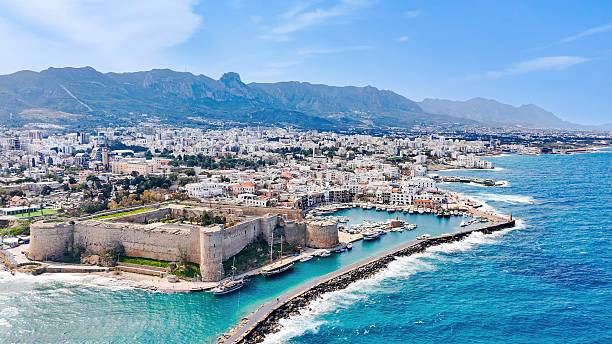
Kyrenia, known locally as Girne, anchors most Northern Cyprus itineraries, and it earns that spot easily. The horseshoe-shaped harbor, lined with restaurants and cafés housed in centuries-old stone buildings, sits directly beneath Kyrenia Castle, a fortress with roots tracing back to the Byzantine era and later expanded significantly under Venetian rule. Walking the castle's ramparts gives sweeping views across the harbor and the Mediterranean beyond, and the shipwreck museum housed inside displays an actual merchant vessel dating back over two thousand years, recovered from the seabed nearby.
Just outside Kyrenia, Bellapais Abbey sits in the hills above the town, a Gothic monastery ruin surrounded by cypress trees with views stretching down toward the coast. The abbey's setting, quiet and slightly removed from the busier harbor scene below, makes it a genuinely peaceful stop, especially in late afternoon when the light catches the stone ruins at an angle that photographs beautifully without any real effort.
Coverage throughout Kyrenia itself stays strong and consistent, handling the steady flow of visitors around the harbor and nearby hotels without any real strain.
St. Hilarion Castle and the Mountain Fortresses
Northern Cyprus holds an unusual concentration of mountaintop castles for a region its size, and St. Hilarion Castle stands out as the most dramatic. Perched high in the Kyrenia mountain range, the castle's ruins sprawl across multiple levels connected by steep stone stairways, with the upper sections offering views across both the northern coastline and, on clear days, toward the distant Turkish mainland. Local legend ties the castle to inspiring elements of fairy tale architecture, and walking through its weathered towers and courtyards, it's easy to understand why that story took hold.
Buffavento Castle, further along the same mountain range, sits at a higher elevation and requires a steeper approach, rewarding the effort with an even more commanding view across the island. Fewer visitors make it out to Buffavento compared to St. Hilarion, which gives it a quieter, more solitary atmosphere for anyone willing to handle the climb.
Signal thins out somewhat on the winding mountain roads leading to both castles, though main viewpoints and parking areas generally maintain workable coverage given the steady tourist traffic through the region.
Famagusta: Walls, Ruins, and Layered History
Famagusta, known locally as Gazimağusa, holds one of the most intact medieval walled cities anywhere in the Mediterranean. The city's massive Venetian fortifications encircle an old town packed with Gothic churches, many converted into mosques during the Ottoman period, creating an architectural layering that tells the story of the island's shifting rulers across several centuries. The Lala Mustafa Pasha Mosque, originally built as a Gothic cathedral in the fourteenth century, stands as the centerpiece of the old town, its facade still carrying obvious cathedral-era details despite the minaret added centuries later.
Othello Castle sits near the harbor within the walled city, its name tied to Shakespeare's play through local tradition connecting the fortress to the story's Venetian setting, regardless of how loosely historical that connection actually is. Climbing through the castle's chambers and up onto its walls gives a strong sense of Famagusta's role as a heavily fortified trading port during the Venetian period.
Just outside the modern city, the ruins of ancient Salamis spread across a large archaeological site right along the coast, with Roman-era columns, an amphitheater, and bath complexes set close enough to the sea that the sound of waves accompanies most of the walk through the ruins. Salamis rewards a couple of unhurried hours, ideally in the cooler parts of the day given how exposed the site is to direct sun.
Famagusta's old town and surrounding areas maintain solid coverage throughout, supporting the steady stream of visitors moving between the walls, the mosque, and the harbor.
Nicosia and the Karpaz Peninsula
Nicosia, split between Northern Cyprus and the island's southern side, offers a genuinely unusual experience for travelers interested in divided cities. The northern side's old town, contained within Venetian walls, holds the Selimiye Mosque, another converted Gothic cathedral similar in style to Famagusta's Lala Mustafa Pasha Mosque, along with the atmospheric Büyük Han, a restored Ottoman caravanserai now filled with small shops, cafés, and craft workshops arranged around a central courtyard.
For travelers wanting a genuinely different pace, the Karpaz Peninsula stretches out toward the island's northeastern tip, home to some of the least developed beaches remaining in the Mediterranean and a population of free-roaming donkeys that wander the region's roads and beaches without much concern for passing traffic. Golden Beach, found near the peninsula's far end, delivers long stretches of sand with barely any development in sight, a rare find for coastal Mediterranean destinations at this point.
What Data Plans Typically Include
Northern Cyprus eSIM plans generally structure around a data allowance paired with a fixed validity window, something like five gigabytes over ten days, giving travelers a clear sense of what they're working with right from activation. Calling and texting sometimes come bundled, sometimes sit as a separate option, and with WhatsApp and similar apps handling most communication for international visitors anyway, plenty of travelers rely on those instead of traditional cellular minutes.
Hotspot access is worth checking for, since turning your phone into a personal WiFi point comes in handy whether you're working from a laptop at a Kyrenia café or sharing a connection with travel companions while exploring Famagusta's old town together.
Matching your plan's validity window to your actual itinerary keeps things simple. A trip combining Kyrenia's harbor, a mountain castle day, and a stretch out toward the Karpaz Peninsula can easily fill ten days or more, so picking a plan duration that covers your full route from arrival to departure keeps your connection steady throughout.
How to Install an eSIM on iPhone
Setting up an eSIM on iPhone takes just a few minutes. Connect to WiFi first, since downloading the profile needs internet access.
Open Settings, tap Cellular (labeled Mobile Data on some models), then tap Add eSIM, followed by Use QR Code. The camera opens automatically, and you point it at the QR code your provider sent by email or displayed through their app. The phone reads the code, shows a summary of the plan, and asks for confirmation.
Tap Continue, and iPhone guides you through labeling your lines, perhaps naming your home SIM "Personal" and your new Northern Cyprus eSIM "Travel" so they're easy to tell apart. You'll choose which line handles iMessage and FaceTime, which handles Cellular Data by default, and whether Data Roaming should switch on for the new line. Set the Northern Cyprus eSIM as your default data line for the trip.
Installation usually finishes within thirty seconds. Test the connection by briefly turning off WiFi and loading a webpage. If your QR code won't scan, most providers offer manual entry as a backup, found under Add eSIM then Enter Details Manually.
How to Install an eSIM on Samsung
Samsung's process lives in a slightly different menu but follows the same general logic. Start on WiFi, since the profile download needs internet access.
Open Settings, scroll to Connections, and tap SIM Manager. Look for Add eSIM near the bottom of the screen, tap it, and scan the QR code with your camera when prompted. Once the phone reads the code, a summary screen appears, and you confirm to proceed with the download.
After installation, return to SIM Manager, where your new Northern Cyprus eSIM sits alongside your home line. Tap on it to rename it if you'd like something clearer than the default carrier label, and confirm Mobile Data and Data Roaming are toggled on for the Northern Cyprus line specifically. Samsung also lets you set preferred networks per SIM, useful for routing calls through your home number while data flows exclusively through the Northern Cyprus eSIM.
If your Samsung phone doesn't show an Add eSIM option, double-check the exact model number, since certain regional variants, particularly some sold on carrier contracts, ship with eSIM support locked until the device is unlocked or fully paid off.
Keeping Your Home Number Reachable
Most modern devices support dual SIM functionality, letting your home carrier's line run alongside your new Northern Cyprus eSIM at the same time. Your regular number stays reachable for calls and texts, while the Northern Cyprus eSIM handles data, giving you the best of both without needing to swap anything during the trip.
Check your dual SIM settings to specify which line handles data by default, and set the Northern Cyprus eSIM as your primary data line while keeping your home number active for calls only. This setup lets you stay reachable on your usual number while your data flows entirely through the local connection.
Getting the Most Out of Your Plan
A workable estimate for daily data use runs around one gigabyte for moderate activity covering maps, messaging, and browsing, climbing closer to two gigabytes for travelers streaming music or video, or making frequent video calls back home while exploring somewhere like the Karpaz Peninsula's quieter corners.
Installing your eSIM ahead of departure gives you plenty of room to test everything calmly before you actually need it, and confirming your phone supports eSIM through a quick settings check or a call to your home carrier beforehand means one less thing to think about once you land.
Building the Right Plan for Your Trip
There's no single ideal setup for every Northern Cyprus itinerary. A short Kyrenia and Nicosia trip calls for a plan built around solid coverage in well-connected towns, which both handle data reliably regardless of provider. A longer route weaving through mountain castles, Famagusta's walled city, and out toward the Karpaz Peninsula benefits from broader network access given how much the terrain shifts along that path.
What matters most is matching your data allowance, network access, and validity period to your actual route, rather than grabbing whichever plan appears first in a search. A little planning beforehand, maybe fifteen minutes total, sets up smooth connectivity across a region where the scenery shifts from a bustling harbor town to a Crusader fortress on a mountain ridge within the same afternoon.
Understanding how Northern Cyprus eSIMs function, which network suits your route, and how to get everything installed correctly puts you in solid shape before you've even boarded your flight. Staying connected shouldn't be the part of your Northern Cyprus trip you're thinking twice about, and with the right eSIM sorted ahead of time, from Kyrenia's harbor to Famagusta's ancient walls, it genuinely won't be.
For your travels, eSIMfo provides a seamless solution to keep you online throughout your journey.